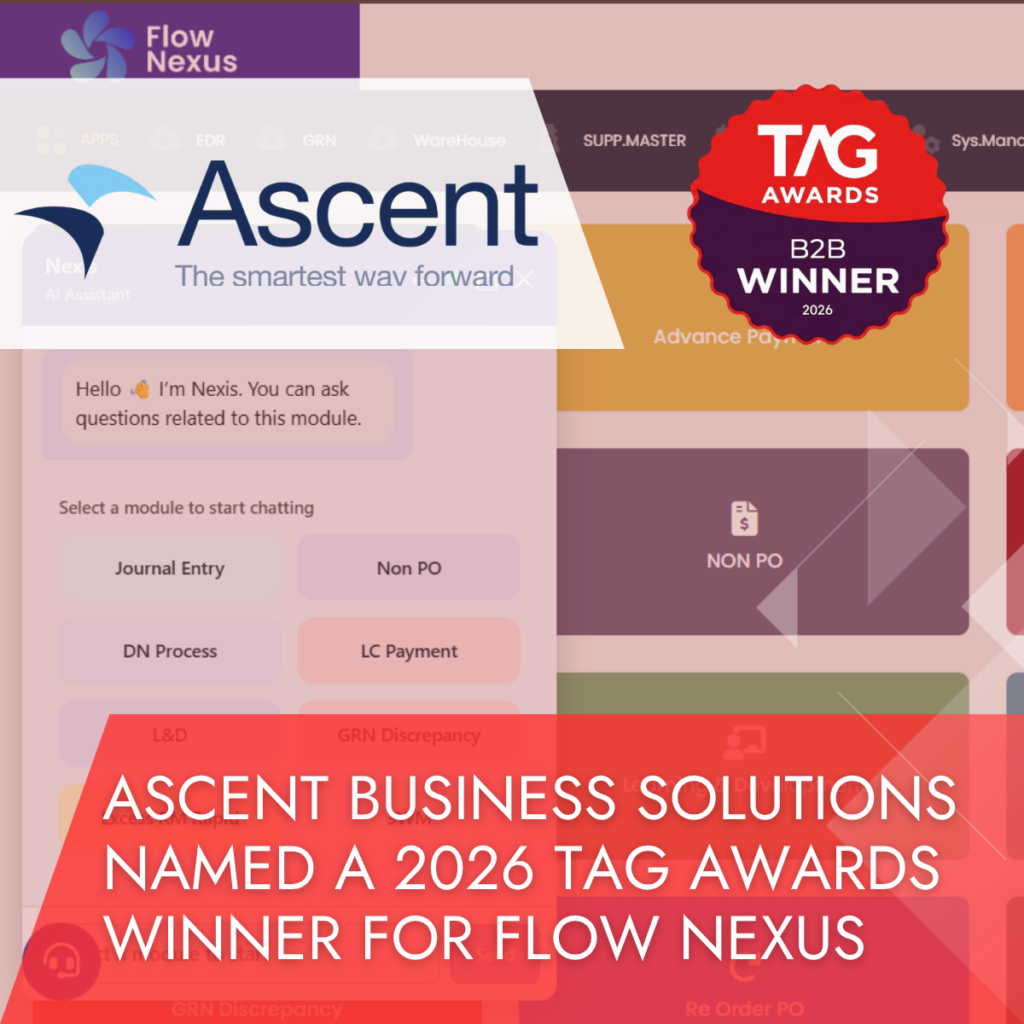
Ascent Business Solutions Named a 2026 TAG Awards Winner for Flow Nexus
Eliminating Back-Office Inefficiencies
There is a particular kind of inefficiency that shows up in almost every growing organization.
An employee sends an email.
Someone else waits for a response.
A spreadsheet gets updated.
A document gets attached.
A manager approves something.
Someone enters the same information into another system.
Then someone checks it again.
None of those individual steps seem especially complicated. Together, they can consume an enormous amount of time.
Ascent Business Solutions built Flow Nexus to change that.
Flow Nexus - Enterprise Transformation has earned Ascent Business Solutions 2026 TAG Awards Winner recognition for its innovative approach to automating complex enterprise processes.
Process Automation Beyond Basic Bots
Flow Nexus is an RPA-enabled internal process automation framework designed to turn manual, fragmented back-office processes into connected, auditable digital workflows.
Rather than treating robotic process automation as a collection of individual bots, Ascent built Flow Nexus as a broader framework that combines RPA, workflow orchestration, business rules, ERP connectivity, automated validation, reconciliation, security, and audit trails.
That distinction is important.
A bot can automate a task.
A connected framework can automate a process.
Flow Nexus is designed to handle activities such as journal voucher creation, invoice validation, reconciliation, data synchronization, document generation, approvals, exception handling, and escalation.
The platform can integrate with existing enterprise systems rather than requiring organizations to rip out the technology they already use. Its workflow layer manages routing, approvals, validations, SLAs, exceptions, and escalations, replacing email-driven coordination with system-driven accountability.
And there is a very practical reason that matters.
Businesses don't necessarily want to replace their entire technology stack every time they want to improve a process.
They want the process to work better.
Flow Nexus is designed to work alongside existing ERP environments, helping organizations automate high-volume, rule-based work without requiring a disruptive core-system replacement. Its modular architecture also allows processes, business units, and geographies to be added as organizations grow.
Measurable Results and Built-In Governance
The reported results are meaningful.
Ascent says Flow Nexus has delivered 35% FTE productivity improvements and approximately 60% reductions in processing and cycle times. The company also reports $2 million in client-signed benefits, including $500,000 realized within the first six months.
Those numbers get to the heart of what enterprise automation should be about.
Not automation for automation's sake.
Better use of people's time.
Faster processes.
Fewer manual handoffs.
More visibility.
And the ability to grow without automatically adding headcount at the same rate.
There is another piece of Flow Nexus that deserves attention: governance.
The framework incorporates role-based access controls, approval matrices, SLA monitoring, automated documentation, and digital audit trails. That means governance isn't something added after a process has been automated. It is built into the workflow itself.
The TAG Awards judges recognized both the practicality and the potential of that approach.
Anthony Lopez noted that Flow Nexus brings RPA, workflow orchestration, business rules, ERP connectivity, and governance together in a unified framework rather than relying on isolated automation. He also highlighted the measurable productivity, cycle-time, and financial improvements.
Judge Clay Schwabe focused on another aspect of the platform: its future potential.
“Being future ready is such a key talking point that I suggest it is a major campaign focus!”
That future-facing piece is built into the architecture. Because Flow Nexus standardizes workflows, data, validation, and audit trails, the company sees a path toward incorporating AI-assisted decisioning and predictive analytics as those technologies mature.
For businesses that have spent years working around manual processes, that could be an important shift.
The goal isn't simply to make the old process faster.
It is to rethink how the process works in the first place.
And sometimes the most valuable innovation isn't the technology people see. It's the hours of work that technology gives back to the people who actually keep a business moving.