
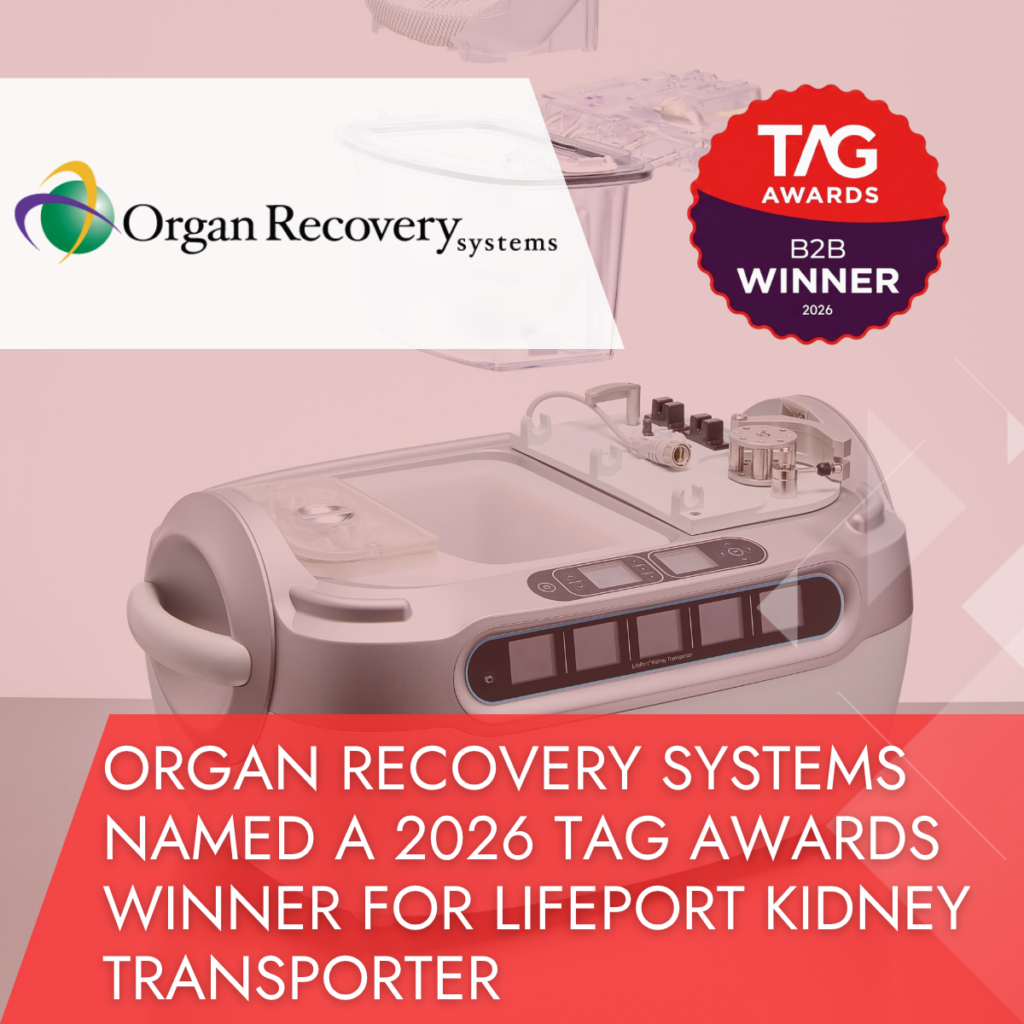
Organ Recovery Systems Named a 2026 TAG Awards Winner for LifePort Kidney Transporter
The Vulnerability of Organ Transport
A donated organ does not stop being vulnerable simply because it has reached the point of transportation.
For transplant teams, the journey between donor and recipient is a race against time, biology, logistics, weather, distance, and an enormous amount of coordination.
Organ Recovery Systems has spent more than two decades working on one critical part of that journey: keeping donor kidneys viable while they travel.
Its LifePort Kidney Transporter has been named a 2026 B2B Innovation TAG Awards winner.
Hypothermic Machine Perfusion Innovation
The concept behind LifePort is deceptively simple.
Traditional organ transportation has relied heavily on static cold storage, essentially placing a donated kidney in a cooler filled with ice and transporting it to the transplant center.
LifePort takes a different approach.
Instead of simply keeping the organ cold, the system actively preserves the kidney using hypothermic machine perfusion, pumping a preservation solution through the organ while monitoring critical parameters along the way.
The technology is designed to create a safer, more controlled environment for the kidney during transport.
And the engineering goes considerably further than the pump itself.
LifePort includes pressure-controlled perfusion, ultrasonic bubble detection, controlled flow increases, cold-storage backup, and an integrated sterile perfusion circuit. The transporter weighs approximately 45 pounds when fully loaded and is designed to be moved by a single clinician and transported by ground or air.
Real-Time Remote Monitoring and Visibility
More recently, Organ Recovery Systems has added another layer: connectivity.
Its Remote Monitoring and Tracking platform securely transmits GPS location and live perfusion information to a cloud-based portal. Transplant teams can monitor the kidney's location, flow, pressure, temperature, and other critical information from an internet-connected device.
In other words, the team doesn't have to wonder where the organ is or how it is doing.
They can see it.
That combination of active preservation and real-time visibility has helped LifePort become a major part of the transplant ecosystem. Organ Recovery Systems reports that LifePort has preserved more than 275,000 donor kidneys and is used by more than 400 transplant programs in 49 countries. The platform is also supported by long-term clinical evidence, including 10-year follow-up data published in the New England Journal of Medicine.
Then there are the moments that don't fit neatly into a spreadsheet.
One Organ Recovery Systems support call involved a kidney from a 10-year-old donor. Another involved a kidney large enough that its anatomy was obstructing flow through the connection to the LifePort system. In both cases, Organ Recovery Systems staff used video support to understand what was happening and help the clinical team adjust the setup so the kidneys could continue to be properly perfused.
In another example, a kidney made an 18-hour journey during severe winter weather, with the LifePort system maintaining perfusion throughout the trip.
Those stories illustrate something important about medical technology: the device is only part of the solution. The people, support systems, data, and experience surrounding it matter, too.
Industry Adoption and Award Recognition
That was reflected in the TAG Awards judging.
Anthony Lopez praised LifePort's evolution from an organ preservation device into a connected platform that gives transplant teams real-time visibility into both organ location and perfusion parameters. He also highlighted the scale of adoption and long-term clinical evidence behind the technology.
Judge Tim Parrish put it another way:
“It's not just the hardware, it's the combination of active perfusion, real-time remote monitoring, and actual human perfusion support on the helpline that catches problems other systems might miss.”
That combination is at the heart of the LifePort story.
A donated organ represents an extraordinary opportunity for one person and an enormous amount of work by many others. Reducing risk during transportation may sound like a narrow technical problem, but for the person waiting for that organ, it is anything but narrow.
LifePort is helping make that journey more controlled, more visible, and more dependable.